

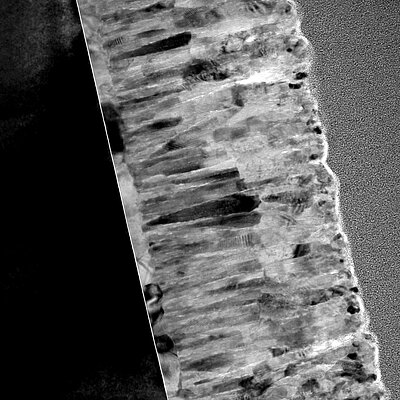
Rust. On Earth, it's what's left when metal gives up. On the Moon, it's a reserve of oxygen.
This micrograph shows the moment after. Low-temperature hydrogen plasma has just pulled the oxygen out of the iron oxide. The structure, until then ordered in neat columns, has broken into distinct layers. That disorder is good news: it's the signature of oxygen leaving. Now it just has to be caught. That's the whole challenge.
The image comes from the PLASREDREGO project, co-funded by the European Space Agency and carried out at ESRIC, the European Space Resources Innovation Centre — an initiative of the Luxembourg Space Agency and LIST, in strategic partnership with ESA.
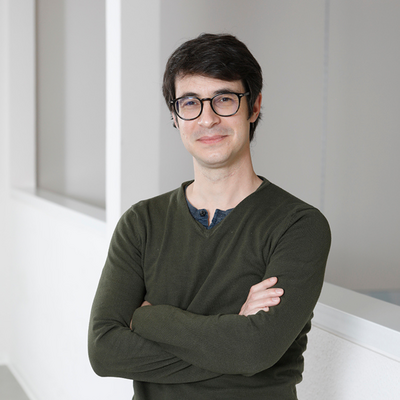
Simon Bulou works on coatings, photocatalysts, 3D-printed parts. Very terrestrial things. Then someone asks him a science-fiction question that has become an engineering problem: how do you get oxygen out of lunar soil?
He is a physicist at LIST, in the Plasma and Vapor Deposition Processes group. His tool is plasma: ionised gas that reshapes matter atom by atom. With PLASREDREGO, run alongside Kathryn Hadler at ESRIC, he points that same technique at the Moon. The team's results appeared in Vacuum in 2025, with Marko Sikirić as lead author.
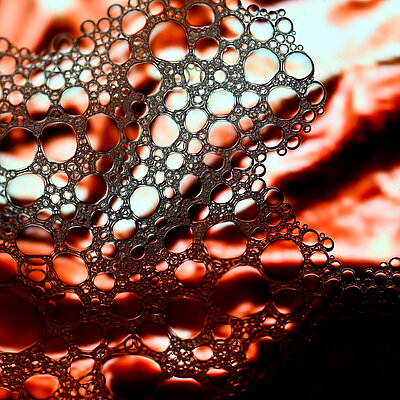
This photographic artwork layers two images. The background — softly blurred in the final piece — is aluminium foil lit with LED light, its reflections evoking the rust-red terrain of the Moon.
In the foreground, a container of soapy water gives rise to clusters of bubbles of varying sizes: they imagine the oxygen that researchers are working to extract from lunar soil. Together, the two layers merge into a single image, a rust-toned surface releasing the resource it holds.
Inspired by the scientific image Transforming iron oxide for space exploration from LIST researchers, revealing the hidden structure of iron oxide as part of research into extracting oxygen from lunar soil.
Artwork by: Tom FABER, Luxembourg
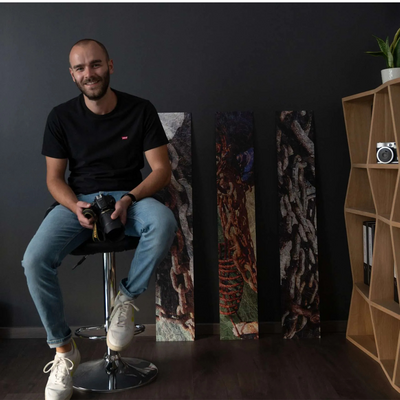
Tom Faber is the artist behind Oxygen from the rust, his response to the micrograph from the PLASREDREGO project. He worked from the image alone: aluminium foil lit to suggest the rust-red ground, soap bubbles standing in for the oxygen the researchers are trying to release.
Born in 1993 and based in Luxembourg, he trained in media design in Cologne, worked as a freelance photographer, and has been a full member of the Cercle Artistique de Luxembourg since 2013. His practice is macrophotography, layered and recomposed on screen: oil and light, ferrofluid pulled into shape by magnets — physical effects turned into abstract images.
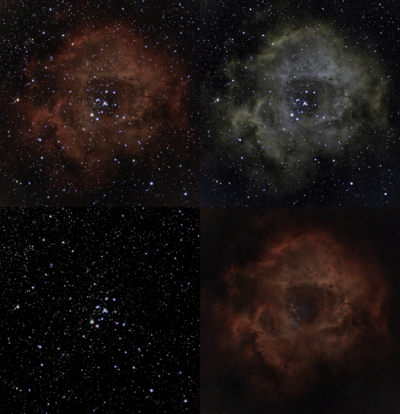
Four views of the same nebula, 5,000 light-years away. This mosaic is what happens when a telescope's raw data passes through artificial intelligence: the same object, enhanced, re-observed, and read in ways the human eye alone would miss.
The image comes from the MILAN and MILAN2 projects, co-funded by Vaonis and the Luxembourg National Research Fund, which produced an AI toolbox for processing high-resolution astronomical images.
Scientist and image: Olivier Parisot (LIST). Captured with a Vespera telescope in Lorry-lès-Metz, France.
The telescope that took this image is one anyone can buy. A Vespera, consumer-grade, set up one evening near Metz. Olivier Parisot used it himself.
The research starts afterwards. These instruments produce thousands of frames - which can be noisy, blurred, streaked by passing satellites. He builds the AI toolbox that cleans and enhances them. A Lead Research & Technology Associate at LIST, he leads MILAN and MILAN2 with French telescope manufacturer Vaonis: an AI toolbox, open datasets, a patented denoising method. Twenty years of artificial intelligence, several of them pointed at the sky.
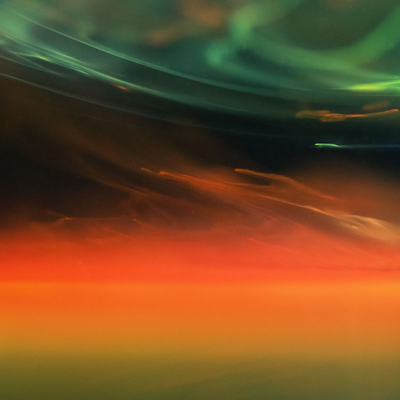
This artwork imagines an extreme close-up of the Rosette Nebula — an abstract mini-universe where new forms constantly emerge and shift, evoking the pull to dive in and float weightless inside this ever-changing world.
Using ink and water, the artist creates movement and organic shapes, then introduces light to bring something entirely new into being. This fusion of fluid dynamics and photography transforms an ordinary medium into an act of cosmic creation.
Inspired by a scientific image from LIST researchers, which led to the development of an AI-powered toolbox for processing high-resolution astronomical image.
Artwork by: Keven Erickson, Luxembourg
Keven Erickson is the artist behind Rosette Nebula, his response to Olivier Parisot's mosaic. Where the scientist points a telescope at a cloud of gas 5,000 light-years away, Erickson made his nebula on a table: ink dropped into water, light introduced at the right moment, fluid dynamics photographed as it happens. An abstract mini-universe where forms keep emerging and shifting.
Born in Luxembourg, he studied art at the Lycée technique des Arts et Métiers before leaving for the United Kingdom, where he took a BA in photography at Solent University in Southampton in 2003. He worked in London, then in Krakow, and has been based in Luxembourg since 2010. Alongside his own practice he works for the Photothèque de la Ville de Luxembourg, has taught photography at the National Adult Education Centre and runs workshops.
When science meets art opens at the Nuit de la Culture on 6 October 2026: four visuals in the public space in Belval, two scientific images and the two artworks they inspired.
Our thanks to the Esch-sur-Alzette and the organizers for letting science out into the streets.
