


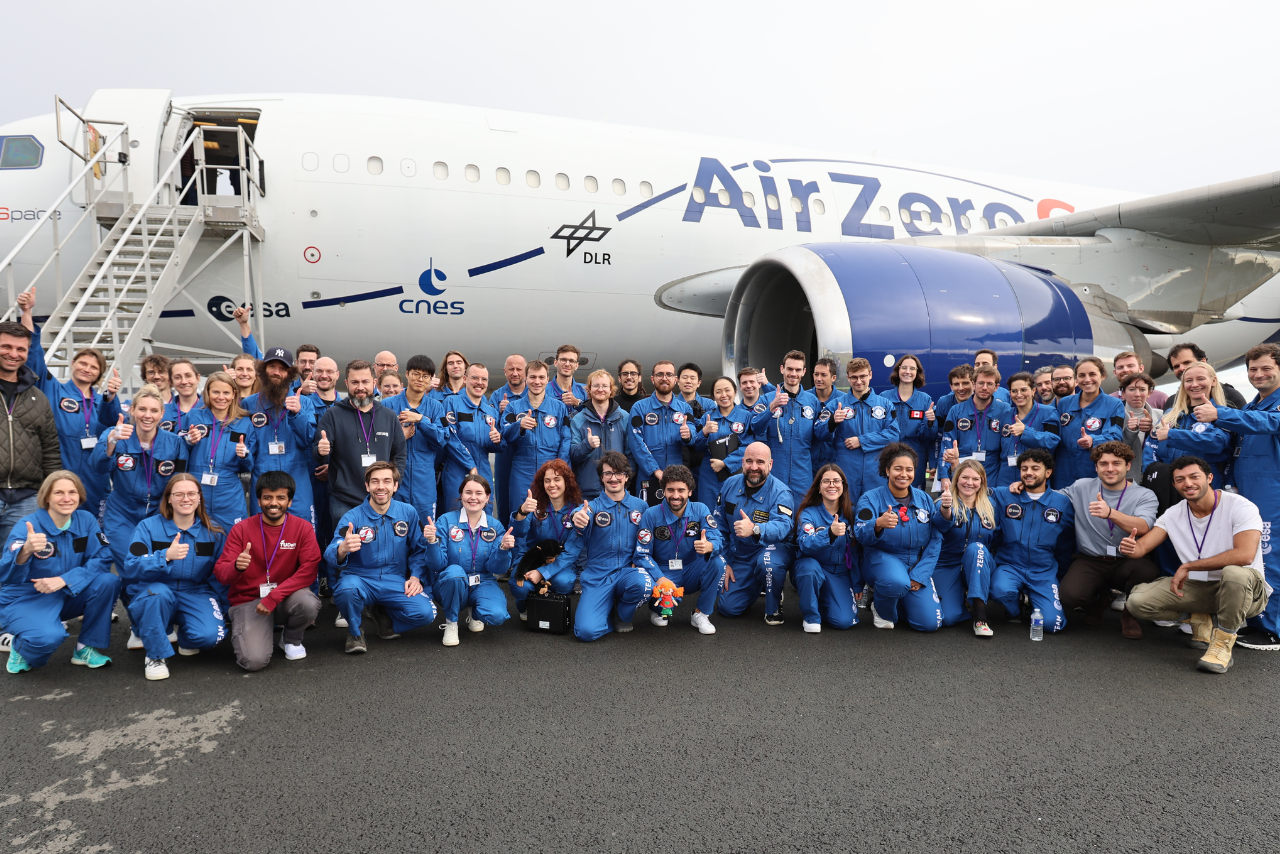
The European Space Resources Innovation Centre (ESRIC) has taken an important step towards future missions to the Moon by successfully completing its first participation in a European Space Agency (ESA) parabolic flight campaign.
Over three dedicated flights from Bordeaux, France, ESRIC researchers tested new technologies designed to transport and sort lunar soil, known as regolith, in conditions similar to those on the Moon. The work forms part of a doctoral research project supported by the Luxembourg National Research Fund (FNR) under the PEARL Programme (P21/MS/15473458), led by Principal Investigator Dr Kathryn Hadler.
The experiment, called PARTICLE (Performance Assessment of Regolith sorTing In Controlled Lunar-like Environment), was carried out by a team of six ESRIC researchers: Xiaochen Zhang, Abhimanyu Shanbhag, Joseph Dyson, Dr Jarrett Dillenburger, Dr. Alvaro Estupinan Donoso and Dr Navid Aminnia. On board the Airbus A310 Zero-G aircraft operated by Novespace, the team completed 93 so-called “parabolas”, short flight manoeuvres during which the aircraft follows a special trajectory to reproduce reduced gravity.
While the aircraft normally flies under Earth’s gravity, during each parabola it briefly enters a regime where passengers and equipment experience gravity similar to that on the Moon, which is about one-sixth of Earth’s pull. These few seconds are enough to run a series of tests that cannot be performed in a standard laboratory.
For ESRIC, this flight campaign represents a major milestone. The PARTICLE experiment provided the first in-flight validation of the centre’s concepts for lunar regolith transportation and particle size classification. Being able to handle lunar soil efficiently and reliably will be essential for future missions that aim to build infrastructure on the Moon or use local resources, for example to produce construction materials, water or oxygen.
In addition to valuable scientific data, the campaign also allowed the ESRIC team to gain operational experience in preparing and running an experiment under the constraints of a space-like environment. This type of know-how is crucial as Europe and its partners prepare for a new era of lunar exploration.
The ESRIC experiment was part of ESA’s 88th parabolic flight campaign, which brought together nine research teams working on different aspects of life and work in lunar conditions. Other studies on board examined how the human body adapts to partial gravity, how astronauts might recover their balance after long periods of immobility, how injuries could be treated without immediate access to specialists, and how to improve fire safety in future lunar habitats. Together, these projects contribute to making future missions safer and more sustainable.
ESRIC extends its thanks to the European Space Agency for selecting the PARTICLE experiment and to Novespace for its technical support throughout the preparation and flight operations. The results of this campaign will feed directly into ESRIC’s research and testing activities in Luxembourg, reinforcing the country’s role in developing the technologies needed for Europe’s long-term presence on the Moon.