



As local authorities face the dual challenge of digital and ecological transition, an increasing number of municipalities are struggling with the complexity of scaling up and positioning themselves as drivers of urgent and far-reaching change.
For local elected officials, the question is no longer whether their territory should become “smart,” but how to make it happen. Failing to do so risks mounting delays under growing regulatory pressure. This is precisely where the Smart City Hub initiative, led by the Luxembourg Institute of Science and Technology (LIST), comes into play—offering a structured response tailored to the needs of municipalities and local innovators.
Municipalities under strain: materialising change
The local landscape now faces a clear imperative. The “Smart City” call for projects launched in June 2025 by the Ministry of the Economy, SMEs, Energy and Tourism and the Ministry of the Environment, Climate and Biodiversity invites municipalities and intermunicipal unions to commit to projects in smart mobility, energy efficiency and optimised resource management.
Yet many municipalities must operate with limited financial means and stretched human resources, while technical frameworks are still being developed to turn these ambitions into reality. This is compounded by a reinforced regulatory environment: interoperability, data governance and the long-term viability of solutions have become mandatory criteria. At the same time, elected officials point to growing pressure stemming from increasingly high citizen expectations.
On a broader scale, urban realities only heighten this sense of urgency. Cities today must respond to challenges related to resources, air quality, energy efficiency, mobility and security. For municipalities, this means building a coherent model, ensuring sound governance, managing impacts and committing to a deep structural transformation.
The LIST Smart City Hub: a partner for municipalities
It is within this context that the relevance of the LIST Smart City Hub becomes clear. The platform is specifically designed to meet a dual requirement: enabling cities and municipalities to enter the world of smart solutions, while supporting them in a secure, neutral and gradual manner.
In practical terms, the Smart City Hub provides an experimentation framework that supports municipalities throughout their digitalisation journey. It begins with a guided exploration phase, during which cities can identify which approaches best support their missions and which technical solutions suit their specific context. This is followed by technical testing in real-life conditions, and finally by support through to adoption, ensuring the robustness of solutions while integrating regulatory requirements—particularly compliance with frameworks such as the European AI Act and the General Data Protection Regulation (GDPR).
For municipalities, this means no longer facing innovation alone. They can rely on a structured partner to identify relevant use cases, test solutions before committing to large-scale investments, and ensure that selected solutions are sustainable over the long term.
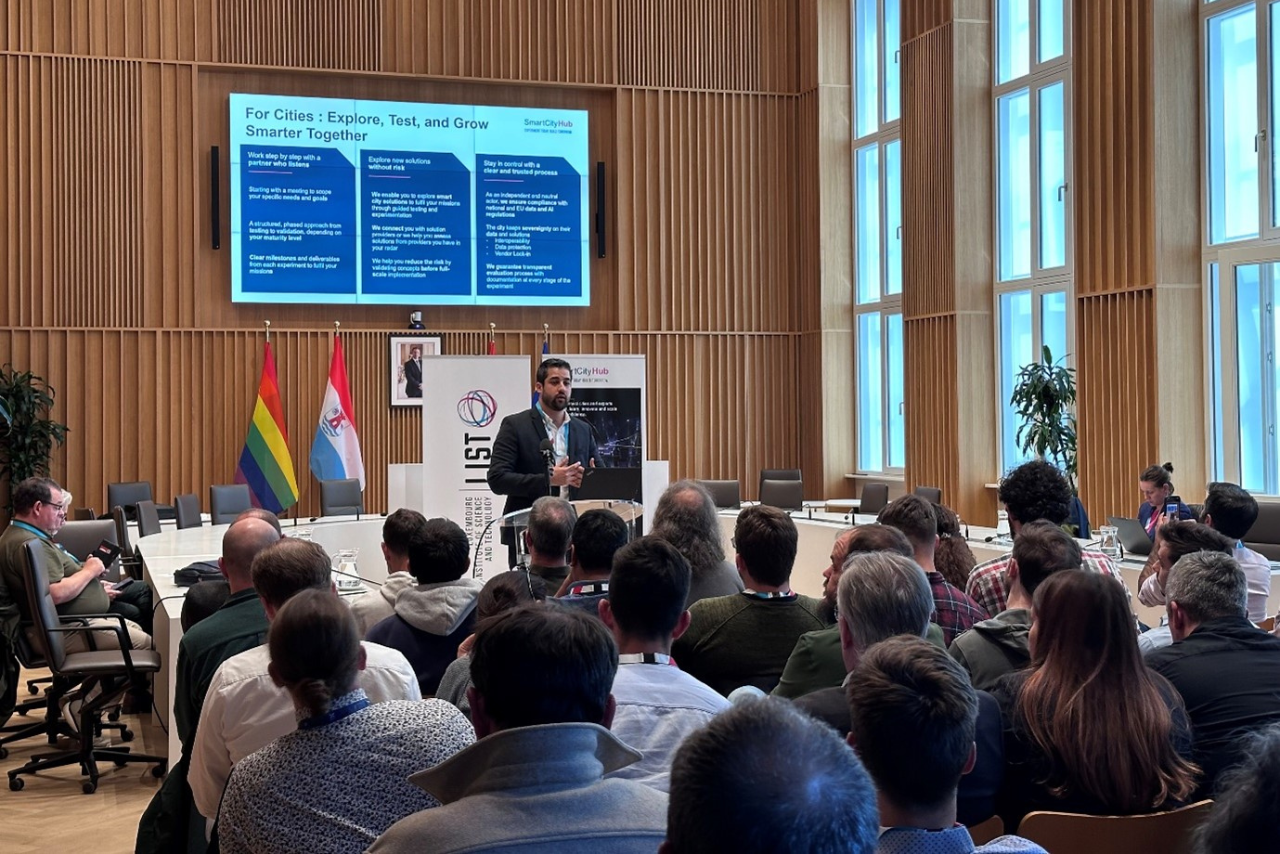
During the Smart City Hub event held on 14 October, organised in partnership with the City of Esch-sur-Alzette and Syvicol, 67 representatives from cities, intermunicipal unions and the innovation ecosystem generated 23 digitalisation project ideas and early-stage proposals for the Smart City call.
“The fact that this initiative is operated by a neutral research institute such as LIST, and that it is embedded within the European network of Testing & Experimentation Facilities (TEF), strengthens its credibility and offers local authorities a rigorous framework,”
says German Castignani, Digital Twin Innovation Centre Manager and AIRA Research Group Leader at LIST.
Tangible added value
For Luxembourg’s municipalities, the Smart City Hub delivers multifaceted added value—starting with risk reduction. A recent study indicates that 95% of AI pilot projects fail. It is precisely in response to this reality that the Smart City Hub positions itself, offering structured support to test prototypes before scaling them up. This phase is critical in avoiding costly mistakes, uncontrolled technological dependencies or projects abandoned due to a lack of results.

The support also extends to interoperability and data governance, which have become essential elements in the context of public calls for projects. Indeed, municipalities are now required not only to innovate, but also to demonstrate their ability to share, secure and replicate solutions.
“Thanks to the LIST Smart City Hub, a municipality gains a partner to put safeguards in place—not just around technology, but around asking the right questions and applying the right protocols,”
German Castignani adds.
Beyond its direct financial impact—by significantly improving success rates in calls for projects—the Smart City Hub primarily helps municipalities set realistic priorities. Projects are thus steered toward solutions that genuinely reflect local needs, whether in mobility, energy, resource management or quality of life. Across all these strategic areas, the Smart City Hub offers a guided pathway tailored to public authorities, with services co-financed under the CitCom.ai project.
Becoming a smart city is not merely about deploying technology. It is about building a strategy, testing solutions, ensuring sound data governance and successfully navigating the transition—with confidence.
For more information, visit: https://smartcityhub.list.lu/