





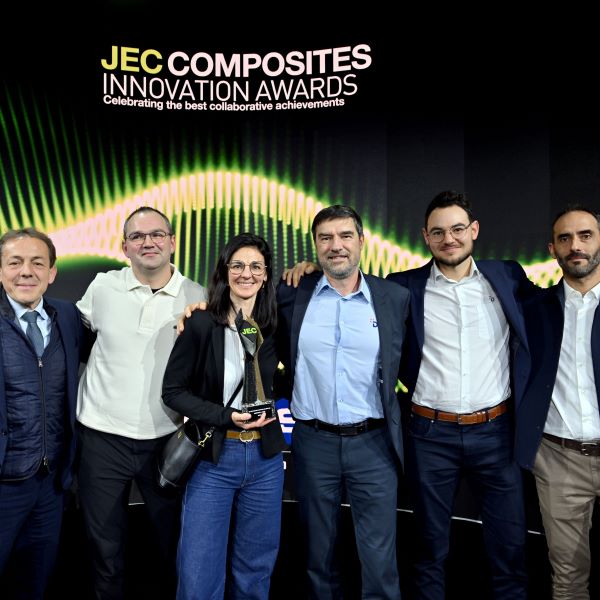
A collaborative aerospace research project involving the Luxembourg Institute of Science and Technology (LIST) has been awarded first prize in the Aerospace – Parts category at the JEC Composites Innovation Awards 2026, one of the most prestigious international distinctions in the field of composite materials.
The award was presented on 12 January in Paris during the JEC World 2026 Premiere ceremony. It recognizes the Highly Loaded Thermoplastic Wing Rib demonstrator, a next-generation aircraft structure developed by Daher, an industry leader in composite manufacturing for aerospace and aeronautics, in close collaboration with LIST and industrial partners Victrex, CETIM and AniForm.
LIST’s patented technology at the heart of the innovation
Within the project, the Structural Composites Unit at LIST played a key technological role by developing and applying its patented infrared welding process, which enables the rapid and lightweight assembly of thick carbon-fibre-reinforced thermoplastic (CFRTP) components. This welding solution makes it possible to assemble two elementary parts into a T-shaped wing rib without mechanical fasteners. This contributes to weight reduction, cost efficiency and recyclability.
The wing rib demonstrator addresses several strategic challenges faced by the aerospace sector, including high-rate production requirements, structural performance, and the reduction of environmental impact. Manufactured from CFRTP and reaching thicknesses of up to 12 mm, the component demonstrates how advanced materials and innovative processes can replace conventional aluminium solutions.
Measurable benefits for future aircraft structures
According to project results, the solution delivers a 22% weight reduction compared with aluminium, alongside 15% lower assembly costs and 25% shorter production cycles compared with bolted assemblies. Over the lifetime of a single-aisle aircraft, the innovation is estimated to reduce CO₂ emissions by 12.5 tonnes per wing rib, while also enabling recyclability – a key advantage of thermoplastic composites over traditional thermoset materials.
Launched in 2021, the project combined advanced simulation, manufacturing and assembly techniques to demonstrate the feasibility of thermoplastic composite wing ribs for future commercial aircraft programmes.
International recognition for collaborative research
Created in 1998, the JEC Composites Innovation Awards recognize outstanding collaborative projects that demonstrate the industrial and societal potential of composite materials. For LIST, this award highlights the impact of its applied research activities in aerospace manufacturing and its ability to translate scientific expertise into industrially relevant solutions. The recognition also shows the importance of close collaboration between research organizations and industry partners in addressing the aerospace sector’s challenges related to decarbonisation, competitiveness and large-scale production.
Levent Kirkayak, Head of the Structural Composite Unit at LIST, said: “This award is a strong recognition of the Structural Composite Unit’s ability to translate advanced research into industrially relevant solutions. It reflects the excellence of our teams and, above all, the strength of our collaboration with industry partners. By combining deep materials expertise with innovative manufacturing technologies, such as infrared welding, we demonstrate how close cooperation with industry can accelerate the development of lighter, more sustainable composite structures for the next generation of aircraft.”
Jurgen Joossens, Deputy CEO at LIST stated: “Congratulations to the outstanding teams at LIST and Daher for winning the prestigious JEC Composites Innovation Award 2026. At LIST, we are driven by ambition and tackle transformative, must-have projects that create inspiring value for our partners. Our interdisciplinary approach, combined with a strong focus on sustainability, ensures that innovation is both impactful and responsible. The close collaboration between LIST’s cutting-edge research capabilities and Daher’s industrial expertise exemplifies the best of both worlds—bridging scientific excellence with real-world application.”